

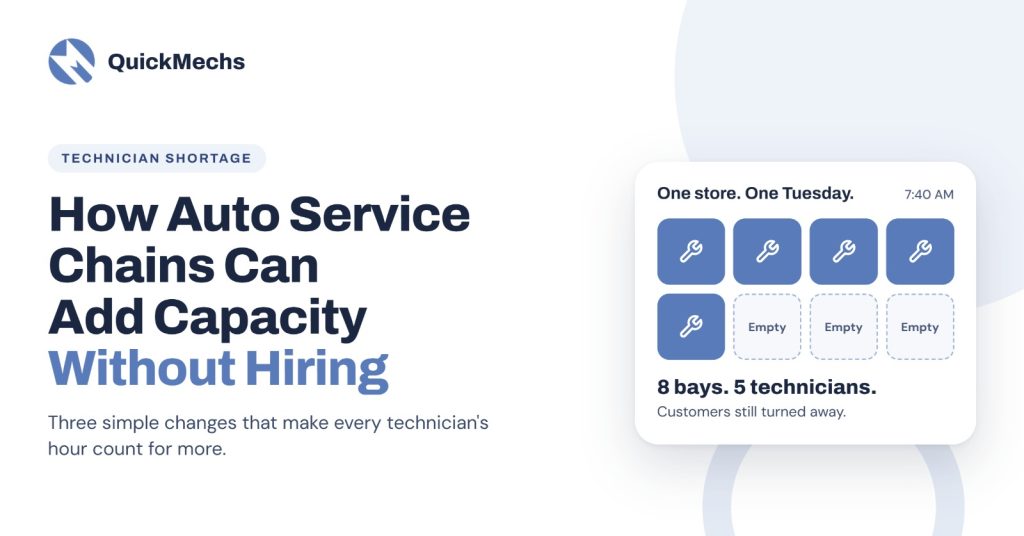
The technician shortage is turning customers away from auto service stores every day. Here is what it looks like on a normal Tuesday, and how one operations leader fixed it without hiring anyone.
Marcus runs operations for 120 auto service stores. On Tuesday morning he is visiting one of them when a delivery driver walks in.
The driver’s brakes are grinding. He needs his van fixed today, because he cannot work without it.
Dana, the store manager, checks the schedule. “The earliest we can do is Thursday,” she says.
The driver thanks her and leaves. He drives to the repair shop across the street.
Marcus looks into the workshop. Three of the eight bays are empty.
Why the Bays Were Empty: The Technician Shortage
“Why did we send him away?” Marcus asks. “Three bays are empty.”
“I have eight bays but only five technicians,” Dana says. “All five are busy. There is nobody free to do the work.”
This is the technician shortage. There are not enough trained mechanics to hire. Marcus has had job ads running for a year, and so has every other chain. According to the TechForce Foundation, the U.S. is short by about 20,000 auto technicians every year.
Marcus does the math. One lost job, in one store, on one morning. He has 120 stores. This happens every day.
A Different Way to Look at It
That night, Marcus thinks about the driver again.
The van needed a simple brake job. Did it really need a bay in the store? Did a technician really need to spend time finding out what kind of van it was and which parts it needed?
Marcus realizes something. He cannot hire more technicians. But he can stop using their time on work that does not need them.
Three Small Changes
Marcus tries three changes in Dana’s store.
1. Know the vehicle before it arrives. Customers give their VIN, the vehicle’s ID number, when they book. The team knows the exact vehicle before it arrives. Nobody has to look it up.
2. Know the likely problem before it arrives. The customer types what is wrong. Software matches that to the vehicle and suggests the likely repair. The technician knows where to start, and the right part can be ready.
3. Do simple jobs where the customer is. Brakes, batteries and basic checks do not always need a bay. A mobile mechanic, a mechanic who travels to the customer, can do them at a home or in a parking lot. The bays stay free for bigger repairs.
The Next Tuesday
A few weeks later, another driver needs his brakes fixed quickly.
This time he books on his phone the night before. He enters his VIN and types “brakes grinding.” It is a simple job, so a mobile mechanic goes to his home at 8:00. By 10:00 the van is fixed and he is back at work.
In the store, the five technicians work on the bigger repairs. The walk-in customers are served too.
Dana has the same eight bays and the same five technicians. Nobody was hired. Nobody was turned away.
How to Beat the Technician Shortage in Your Stores
Marcus and Dana are made up. The problem is real, and so is the solution.
You may not be able to hire enough technicians. You can help the technicians you already have get more work done.
Start with one number. Count the jobs your stores turned away last month. Multiply that by your average repair bill. That is how much the technician shortage is costing you.
Mech IQ by QuickMechs can help. It connects to the booking system you already use. It identifies the vehicle, suggests the repair, and sends simple jobs to a mobile mechanic.
See how it fits your system. Book a 15-minute walkthrough with the QuickMechs team at quickmechs.com.
Technician Shortage: Quick Questions
Can a mobile mechanic do the same work as a shop?
For many jobs, yes. Brakes, batteries and basic checks can be done where the customer is. Big jobs that need a lift stay in the shop.
Do we have to replace the system we use now?
No. Mech IQ adds to the system you already have.