

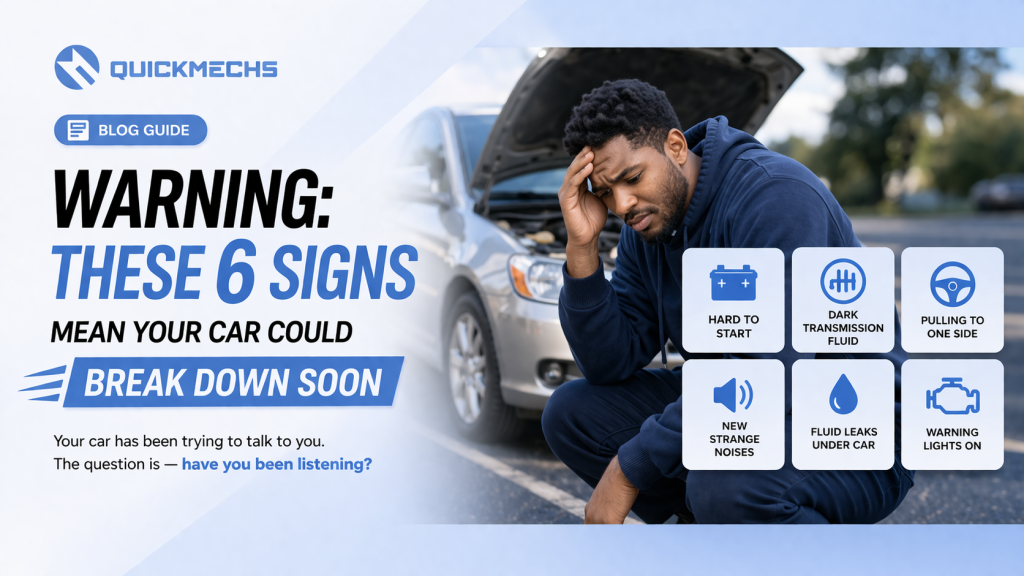
Your car has been trying to talk to you. The question is have you been listening?
Your car has been trying to warn you and the truth is, the warning signs your car is about to break down are almost always there. The question is, have you been paying attention?
Here’s a number that should make you sit up straight: 69 million vehicle breakdowns happen every year in the United States. That’s roughly 1 in 3 drivers getting stranded at some point. Not in a movie. In real life. On real roads. And the most frustrating part? The majority of those breakdowns didn’t come out of nowhere.
Your car almost always gives you a warning. A sound here. A smell there. A subtle feeling that something’s just… off. The problem is, most of us don’t know what we’re looking for or we see the signs and convince ourselves it’s nothing.
This article is going to fix that. Here are 6 warning signs your car could break down soon — and some of them might genuinely surprise you
1. Your Car Takes More Than One Attempt to Start and You’ve Been Ignoring It
You know that little hesitation when you turn the key or press the start button? The moment where you hold your breath for just a half-second longer than normal? Yeah. That’s not a fluke.
A car that hesitates or requires multiple attempts to start is your engine quietly filing a complaint. It could be a dying battery, a faulty starter motor, or a failing fuel pump. Here’s a quick way to decode it: if you hear rapid clicking when you turn the key and the dashboard lights work fine, your starter motor is likely the culprit. If the dashboard lights are also dim or dead, the battery is probably the problem — especially if this happens in cold weather.
Why it matters more than you think: Batteries that are struggling don’t always die gradually. One day they’re slow-starting, the next day — nothing. You’re sitting in a parking lot going nowhere.
The fix? Don’t ignore these warning signs or wait for the car to completely break down. Get it checked before it makes that decision for you.
2. Your Transmission Fluid Has Gone Dark and You’ve Never Even Checked It
Most people have heard of an oil change. Almost nobody talks about transmission fluid. And that silence is costing a lot of people a lot of money.
Here’s something worth knowing: healthy transmission fluid is bright red or pink and smells slightly sweet. The moment it starts turning dark brown or black, something has gone seriously wrong inside your transmission. It means the fluid has been overheating, breaking down chemically, and picking up metal particles from worn internal components. Once you’re at that stage, the fluid is no longer protecting anything — it’s actually accelerating the damage.
The smell is another major clue. Burnt transmission fluid gives off a harsh, acrid odor — some people describe it as burnt toast or scorched rubber. If you’ve ever caught a whiff of something like that after a long drive or while sitting in heavy traffic, don’t just open the windows. Pull the dipstick, wipe it on a white cloth, and look at the color.
A full transmission replacement can cost between $4,000 and $5,000. A fluid change costs a fraction of that. This is one of the easiest things to stay on top of — if you know to look.
3. Your Car is Pulling to One Side While Driving
This one is subtle, and that’s exactly what makes it dangerous. If your car drifts or pulls to the left or right when you’re driving in a straight line, that’s not just an alignment issue to deal with “next month.” It’s a red flag with several possible causes, some of them serious.
Uneven tire wear, under-inflated tires, worn suspension components, or misaligned wheels can all cause this. The tricky part? These issues compound each other. Misaligned wheels cause uneven tire wear. Uneven tires put stress on the suspension. And when the suspension is compromised, your ability to control the vehicle in an emergency — a sudden stop, a swerve to avoid debris — is significantly reduced.
Here’s a simple test: on a safe, empty stretch of road, gently loosen your grip on the steering wheel for a moment. If the car drifts noticeably, it’s time for an inspection. Don’t put it off.
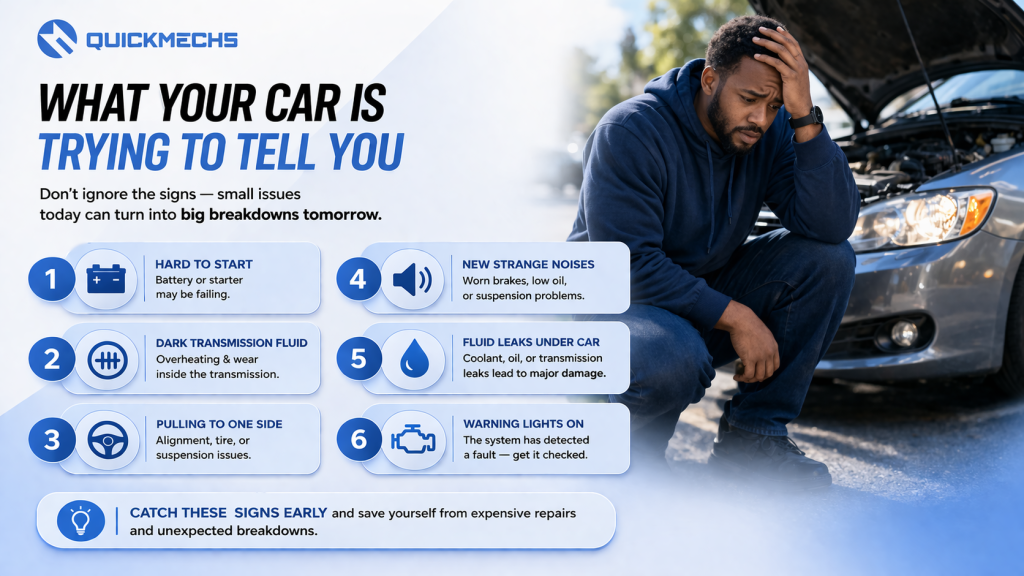
4. You’re Hearing Noises That Weren’t There Before
Cars make noise. That’s normal. But when a new noise shows up, it’s your vehicle’s version of raising its hand and saying “there’s a problem here.”
The challenge is knowing which noise means what. Here’s a quick breakdown of the ones that should immediately get your attention:
- Grinding or squealing from the brakes — your brake pads are worn down. This turns into metal-on-metal contact, which damages your rotors. Ignore it long enough and you lose braking efficiency entirely.
- Ticking or tapping from the engine — this is often a sign of low oil pressure. Oil isn’t reaching all the parts it needs to lubricate, and the engine is letting you know.
- Knocking or pinging sounds from the engine block — could indicate a cylinder issue or loose internal components. This is one of the warning signs of an engine that’s getting close to serious failure.
- Clunking when you go over bumps — points to shock absorbers or struts that are worn out. Your suspension is responsible for keeping your tires in contact with the road. When it fails, your car becomes genuinely difficult to control.
- Clicking when you turn the key — as mentioned earlier, this usually signals a battery or starter issue.
None of these sounds should be filed under “I’ll deal with it later.” Later has a way of becoming the side of the highway.
5. Fluid Spots Are Showing Up Under Your Car
Go outside right now and look at the ground where you usually park. See anything?
A puddle or spots under your car are one of the most overlooked warning signs — because people either don’t notice them or assume it’s just water from the air conditioning. Sometimes it is. But more often, it isn’t.
Here’s how to tell the difference by color:
- Light green or orange, sweet-smelling liquid = coolant leak. Your engine uses coolant to regulate temperature. Run out of it and your engine overheats — which can mean catastrophic, irreversible engine damage.
- Red or brownish spots near the center of the vehicle = transmission fluid leak. As discussed, low transmission fluid leads to overheating, slipping gears, and eventually total transmission failure.
- Dark amber to black oily spots = engine oil leak. Oil is what keeps your engine’s moving parts from grinding each other to dust. Low oil pressure is one of the leading causes of complete engine failure.
- Clear water = usually just condensation from the A/C. You can breathe here.
If the spot has any color to it at all, don’t guess — get it inspected. Catching a minor leak costs very little. Ignoring it can cost you the entire engine.
Fluid leaks are among the most visible warning signs your car is about to break down, yet they’re also the most commonly ignored.
6. Your Dashboard Warning Lights Are On and You’ve Convinced Yourself They Don’t Matter
Let’s be honest. A lot of people drive around for weeks — sometimes months — with the check engine light glowing on the dashboard and tell themselves it’s probably nothing major.
Here’s the reality: that light is connected to your car’s onboard diagnostic system, which monitors hundreds of functions across your engine, transmission, fuel system, and emissions. When it comes on, something has tripped a fault code. It could be something minor like a loose gas cap. But it could also be a failing oxygen sensor, a misfiring cylinder, or early signs of catalytic converter failure — all of which, if ignored, will lead to a much bigger problem down the road.
The battery warning light, the temperature warning light, the oil pressure warning light — these are even more urgent. A rising temperature gauge, for instance, means your engine is overheating right now. That’s a pull-over-immediately situation, not a “I’ll check when I get home” situation.
A pro tip most people don’t know about: you can buy an OBD-II scanner for under $30 from any auto parts store. Plug it into the diagnostic port under your dashboard, and it will give you the exact fault code your car is throwing. That code tells you, and any mechanic, exactly what’s wrong. No guessing. No expensive “diagnostic fees” just to find out what the light is for.
By now, it’s clear that the warning signs your car is about to break down aren’t sudden, they build up over time, quietly demanding your attention.
The Bottom Line: Your Car Rarely Breaks Down Without Warning
Here’s what the data tells us — 30% of all vehicle breakdowns are caused by a faulty battery alone, and the average age of vehicles on U.S. roads is now 12.6 years — a record high. Older cars are twice as likely to break down as newer ones, and most of those breakdowns are preventable.
📊 Check out the full vehicle breakdown statistics here
The signs are almost always there. The clicking start. The strange smell after a drive. The pull to one side. The warning light you’ve been dismissing. Your car is trying to communicate with you and the cost of listening is almost always far less than the cost of not listening.
So What Do You Do When Something Feels Wrong?
This is where it used to get complicated. You’d have to google mechanics, make calls, wait for callbacks, get quotes you couldn’t verify, and hope whoever showed up actually knew what they were doing.
That’s exactly the problem QuickMechs was built to solve.
QuickMechs is an on-demand automotive platform that works just like Uber, but instead of a ride, you’re requesting a certified mechanic or tow truck driver. You open the app, describe your issue, and the platform instantly matches you with the closest available mechanic in your area. You see the price upfront, no surprises, no hidden fees. And you can track the mechanic’s location in real time, right from your phone, exactly the way you’d track a rideshare.
Whether your check engine light just came on, you’ve got a strange noise you can’t place, or you’re already stranded on the side of the road — QuickMechs gets you the help you need, where you are, when you need it.
Wanna know the best part? If you dont have enough money to fix the car, you can apply for our Fix Now, Pay Later feature on our app and we’ll fix the car for you so you can get back on the road and you can pay us back later in installments.
Because breakdowns are stressful enough. Getting help shouldn’t be.
Download the QuickMechs app right now on the App Store or Google Play. and book a mechanic in your location with one tap.