

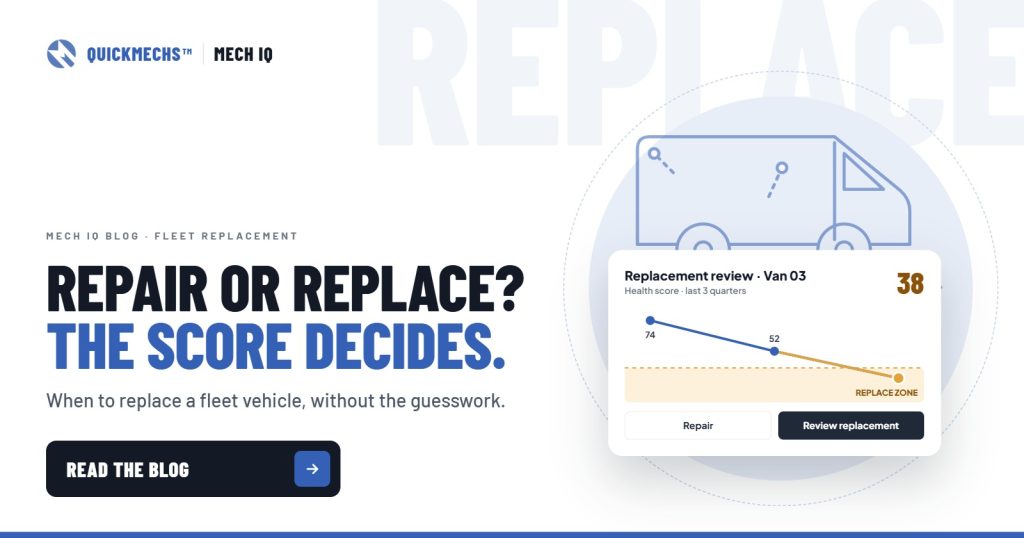
Mech IQ by QuickMechs shows when to replace a fleet vehicle. Its health score, the price of its next repair and its value sit side by side, so repair-or-replace decisions take minutes instead of meetings.
Here is why that matters.
A six-year-old pickup needs a transmission. The quote is big.
Maintenance wants to fix it. Finance wants to stop spending on it. Operations just wants it back on the road. The truck sits in the yard for two weeks while everyone argues.
Bring one vehicle I’m unsure about → Share one vehicle you are deciding on. We show you the numbers side by side.
Why replacement decisions drag on
- One quote, no context. A big number alone does not tell you if the vehicle is worth saving.
- Condition is a feeling. “It’s been reliable” is not a number.
- Value is unknown. Nobody has checked what the vehicle is worth today.
- No agreed rule. Every vehicle starts the same debate from zero.
Waiting makes it worse. Repair prices keep rising: vehicle maintenance and repair prices rose 4.9% in the year to January 2026, according to the U.S. Bureau of Transportation Statistics.
The three numbers that decide it
1. The health score. A low score means more repairs are coming after this one.
2. The fair repair price. A low, average and high price, so you know if the quote is reasonable.
3. The vehicle’s value. If the repair costs a large share of what the vehicle is worth, replacing it may make more sense.
A healthy vehicle with one fair-priced repair: fix it. A low-score vehicle facing a repair worth a big share of its value: replace it.
See the 3 numbers for my vehicle → Book a short call and run them on a vehicle from your fleet.
How to decide when to replace a fleet vehicle in 3 steps
1. Check the score and its reasons. One failing part, or many?
2. Check the quote against the price range. Never decide on one shop’s number.
3. Set a rule once. For example: replace when the repair costs more than a set share of the vehicle’s value and the score is low. Then let the rule decide.
How QuickMechs helps
Mech IQ puts the numbers in the fleet system you already use.
- A vehicle health score that shows whether more repairs are likely.
- A price estimate. A low, average and high price for the repair, based on the VIN.
- Vehicle valuation. The vehicle’s current market value, next to the repair cost.
- Car inspection. A guided check to confirm the rest of the vehicle’s condition.
- VIN verification, so every number belongs to the right vehicle.
If you decide to repair, QuickMechs can do it at your yard. You see the price before you confirm. About 9,000 vetted mobile mechanics across the United States.
Quick questions
When should a fleet replace a vehicle? When the next repair costs too much compared with its value and its health score says more repairs are coming.
Is age or mileage enough to decide? They help, but condition matters more. Two vehicles of the same age can score very differently.
Who should make the call? Agree a rule between operations and finance, so most cases decide themselves.
Bring one vehicle I’m unsure about → One vehicle shows how fast the decision becomes.
Read next: What Is a Vehicle Health Score? · Is This Fleet Repair Quote Fair?