

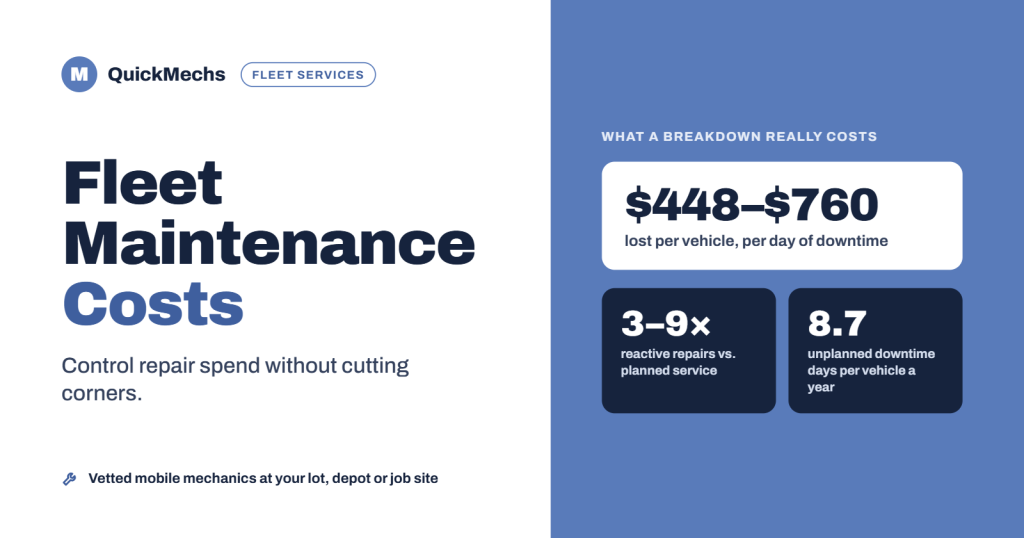
Fleet repair costs are at a record high, and the fix is not spending less on maintenance — it’s spending smarter on it. Repair and maintenance for trucking fleets climbed 8.6% in a single year and is up 45% since 2019. Meanwhile, every vehicle sitting in a shop bay or on a tow hook drains $448 to $760 a day.
The businesses winning on cost aren’t skipping oil changes or stretching brake pads. They’re cutting the waste around the repair: the tow, the shop queue, the surprise invoice, and the breakdown that should never have happened.
Here’s where your money actually goes, why cutting corners backfires, and six steps to bring costs down without risking safety or uptime.
Talk to the QuickMechs fleet team →
Where your repair budget actually goes
The repair invoice is only part of the bill. Most of the waste hides in the hours around it.
| Cost bucket | What drives it | The number to know |
|---|---|---|
| Parts | Supply-chain inflation | Parts prices up 23.8% since early 2020 |
| Labor | Shop rates, overtime, tech shortages | Billed by the hour, including wait time |
| Downtime | Vehicle off the road, driver idle, jobs missed | $448–$760 per vehicle per day |
| Unplanned breakdowns | Skipped or late preventive maintenance | 8.7 days per vehicle per year — roughly $3,900–$6,600 per vehicle |
| Towing & transport | Moving the vehicle to a shop | Paid on top of the repair itself |
| Admin | Chasing quotes, re-keying data, approving invoices | 29% of fleets spend 11–20 staff hours a week on manual data work |
The takeaway: a fleet can pay a fair price for every repair and still overspend badly, because the vehicle sat, got towed, and waited in a queue first.
Why cutting corners costs more
Skipping maintenance doesn’t save money — it moves the cost to a worse moment. Reactive repairs run 3 to 9 times the cost of planned preventive maintenance, according to Decisiv/TMC service benchmark data.
What “saving” usually looks like in practice:
- Delaying a $150 service turns into a roadside breakdown, a tow, and a rush repair.
- Choosing the cheapest shop adds days of queue time while the vehicle earns nothing.
- Running vehicles past inspection risks failed DOT checks, safety incidents, and liability.
- Ignoring warning lights lets a small fault become an engine or transmission job.
The smart move is to keep every repair that protects safety and uptime — and remove the delays, travel, and guesswork wrapped around it.
6 steps to control fleet repair costs
- Know your cost per vehicle. Track every repair, tow, and downtime day by unit. A single fleet-wide average hides the 2–3 vehicles eating your budget — and tells you when repairing stops making sense versus replacing.
- Lock in a preventive maintenance schedule. Set service by mileage or engine hours, not by “when it breaks.” Planned work is where costs are lowest and most predictable.
- Inspect daily, fix early. Quick pre-trip checks catch worn tires, leaks, and warning lights while they’re still cheap fixes.
- Bring the mechanic to the vehicle. On-site and mobile repair removes the tow, the drive to the shop, and the queue. Many routine jobs — brakes, batteries, diagnostics, fluid services — can be done in the lot or on the job site.
- Demand upfront pricing. Approve a clear quote before work starts. No surprise invoices, no padded line items.
- Use one platform for every vendor. Booking, quotes, invoices, and repair history in one place cuts the admin hours spent chasing shops and re-entering data.
How QuickMechs Fleet Services cuts the waste
QuickMechs dispatches vetted mobile mechanics straight to your vehicles — at your fleet lot, depot, or job site — anywhere in the US. You keep the quality repair. You drop the tow, the shop queue, and the lost days.
- Mechanics come to you. On-demand dispatch from a network of about 9,000 verified mechanics, with live tracking.
- Less downtime. No driving to a shop, no waiting for a bay. Many jobs are done the same day, on site.
- Upfront pricing. See the price before you confirm. Clear invoices, secure in-app payment.
- Built-in warranty. Eligible repairs carry a 12-month / 12,000-mile workmanship warranty.
- Inspections in the app. Use the QuickMechs car inspection feature to check vehicles day in, day out and catch problems early.
- Towing when you need it. If a vehicle can’t be fixed on site, book Instant Towing in the same app and track the truck in real time.
- One record for the whole fleet. Bookings, invoices, and repair history in one place — no chasing shops.
The result: your preventive maintenance actually happens on schedule, breakdowns get fixed where they stop, and your vehicles spend their days earning, not waiting.
Your quick cost-control checklist
- Cost per vehicle tracked, including downtime and towing
- Preventive maintenance scheduled by mileage or hours
- Daily inspections logged
- Routine repairs done on site, not at the shop
- Every job quoted upfront before work starts
- All vendors, invoices, and history in one platform
Keep your fleet moving for less
Stop paying for tows, shop queues, and idle drivers. Put QuickMechs on your next repair and see the difference in downtime on day one.
Talk to the QuickMechs fleet team → or call +1-404-307-3227 to build a repair plan that cuts your downtime.
Download QuickMechs and book a mobile mechanic for your fleet today: App Store · Google Play
Read next: Preventive Fleet Maintenance: How to Reduce Breakdowns Before They Happen, a simple daily-to-yearly service schedule your fleet can run on-site.
Sources
- Motive targets fleet repair costs with AI maintenance — FreightWaves, Sep 2026 (ATRI 2026 cost data, Decisiv/TMC benchmarks, FleetNet America downtime data, Motive/FreightWaves Research survey)
- ATRI 2026 Analysis of the Operational Costs of Trucking
- The true cost of vehicle downtime — Fleet Maintenance