

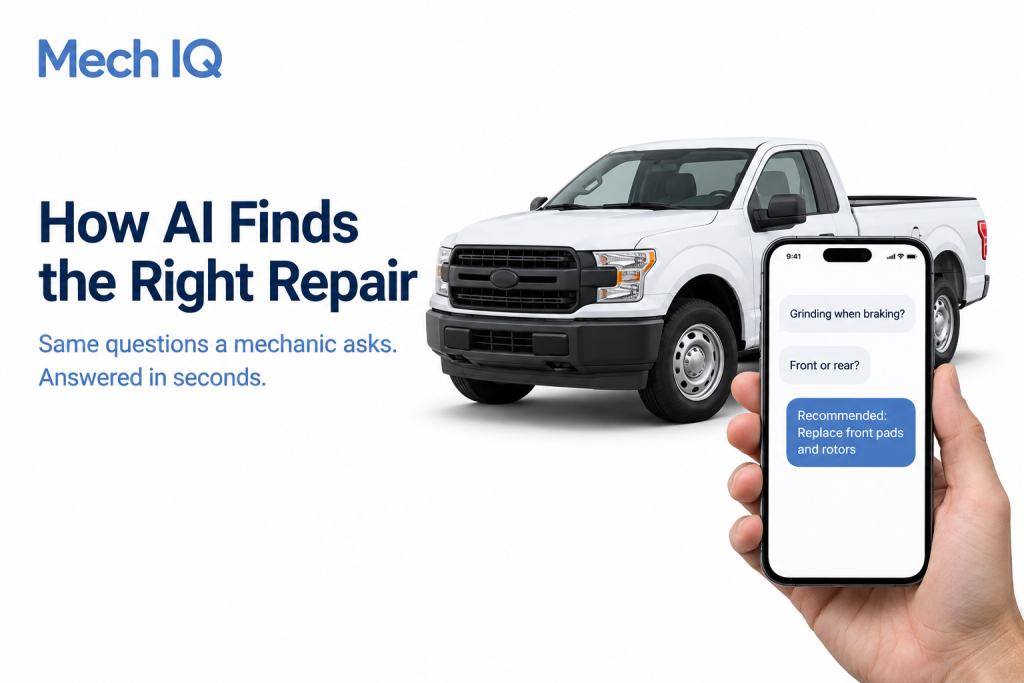
Wondering how an AI can tell you what’s wrong with a vehicle it’s never seen? Mech IQ by QuickMechs gives your team AI repair recommendations that name the exact service a vehicle needs. Each one is backed by VIN data, follow-up questions and an upfront price range, and it all runs through one API that plugs into the systems you already use.
“Can I really trust an AI with my repairs?”
It’s a fair question. You’ve used the same shops for years. You know your drivers and your vehicles.
Then someone tells you an AI can recommend the right repair from a driver’s description and a photo.
It sounds too simple. But the way it works is closer to how a good mechanic thinks than you might expect.
What a good mechanic does first
Before a mechanic picks up a tool, they:
- Ask what’s happening. What does the driver see, hear or feel?
- Ask follow-up questions. When does it start? At what speed? Is it getting worse?
- Check the vehicle details. Make, model, year and mileage change what’s likely.
- Narrow it down. Rule out what doesn’t fit and land on the most likely cause.
Mech IQ follows the same steps, in seconds.
Why one symptom can point to many repairs
A grinding noise when braking could mean:
- Worn brake pads
- Damaged rotors
- A stuck caliper
- A loose heat shield
- Something caught between the pad and rotor
Each one is a different repair at a different price. Guess wrong and you pay twice. That’s why the questions matter as much as the answer.
How Mech IQ’s AI repair recommendation works
- The driver describes the problem. Plain words are fine, and no car knowledge is needed.
- AI diagnostic chat asks follow-ups. It asks the questions a mechanic would, so nothing gets missed.
- Photos add detail. A dashboard snapshot or a photo of the problem area sharpens the answer.
- VIN identification fills in the vehicle. Make, model and year are confirmed from a photo, so the recommendation fits that exact vehicle.
- An exact repair is recommended. You get a specific service like “replace front brake pads and rotors” instead of “inspect brakes.”
- An ODP code is created. It’s one standard code your team, shops and partners can all read.
- A price range comes with it. You see low, average and high prices based on the VIN and the repair.
- Language switches to the user. Drivers can describe problems in the language they’re most comfortable with.
Why fleets trust it
- It shows its reasoning. You see the questions and answers behind every recommendation.
- It fits your vehicle. Recommendations are tied to the VIN instead of a generic guess.
- It’s consistent. The same problem gets the same answer at every site, every time.
- You stay in control. The AI recommends, and your team decides.
How to get started with Mech IQ
- Book a call with the QuickMechs team. Tell us about your fleet, claims or platform.
- Try it on a real problem. Bring a vehicle issue your team dealt with recently and watch Mech IQ work through it.
- Connect it to your systems. It’s one API, so your team keeps the tools they know.
- Start every reported problem with an answer. You get the exact repair, ODP code and price range before the vehicle moves.
Tips for getting the best recommendations
- Ask drivers to report problems as soon as they notice them.
- Encourage clear photos of the dashboard and the problem area.
- Have drivers answer every follow-up question, even the simple ones.
- Compare the recommendation with the shop’s findings to build your team’s confidence.
Be ready before the next problem report
Make Mech IQ the first step every time a driver reports a problem. Book a call today and see how AI repair recommendations work on your own vehicles.
- Book a call: Book a call with the QuickMechs team
- Website: quickmechs.com
- iPhone: Download QuickMechs on the App Store
- Android: Download QuickMechs on Google Play
Missed the first post in this series? Read Know the Exact Repair Before the Vehicle Reaches the Shop.
See how AI repair recommendations work on your fleet. Book your Mech IQ call today.
If a vehicle is unsafe to drive or anyone is in immediate danger, call 911. AI recommendations and price ranges are estimates and may vary by vehicle, location and repair provider.